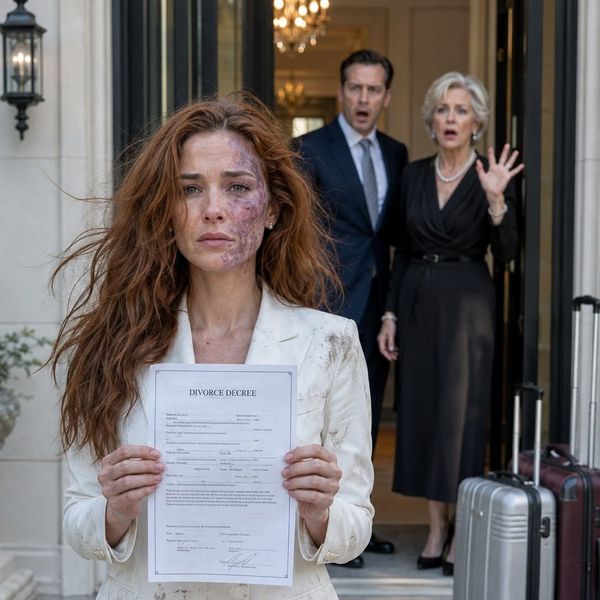
My husband s:lapp:ed a mug of boiling tea across my face when I refused to pay for my mother-in-law's luxury Europe trip. Right in the middle of my video meeting with my company's executive board, he screamed, "Wire the money now, or I'm calling the cops to drag you out of my house!" I didn't cry. I calmly waited for the police. When they arrived, his arrogant smile d:ie:d the second I handed the police my laptop.
Just moments earlier, Christopher had been standing across from me in our marble kitchen, demanding twenty-eight thousand dollars for his mother’s “once-in-a-lifetime European tour.”
Then everything suddenly spiraled out of control.
The mug smashed apart, and boiling tea splashed across my cheek. On my laptop screen, the twelve members of my executive board sat frozen in h0rrified silence.
I didn't scream.
I didn't fight back.
I simply ended the video meeting, reached for a towel, cleaned myself up, and looked directly at him.
His mother, Beatrice, was sitting at the kitchen island in a cream-colored suit, calmly fastening a diamond bracelet that I had unknowingly paid for.
“Don't be dramatic, Savannah,” she said. “He needs somewhere to release his frustration. Families make sacrifices.”
For seven years, I had heard that same excuse in one form or another.
When Christopher’s business collapsed, I paid the mortgage.
When Beatrice needed expensive dental treatment, I covered the cost.
Christopher called it a partnership.
Beatrice called it my responsibility.
But this trip to Europe was different.
Two weeks earlier, while reviewing our household finances, I discovered that Christopher had secretly worked around my security protocols and withdrawn forty thousand dollars from our emergency fund.
I hadn't confronted him about it.
Not yet.
I wanted to know exactly what he had been doing first.
So I spent night after night tracing every transaction, checking every suspicious receipt, and uncovering every lie he believed he had successfully hidden.
That was why, when Christopher walked into the kitchen that morning and demanded another twenty-eight thousand dollars for his mother's vacation, I gave him the one answer he clearly hadn't expected.
“No.”
That was when the argument began.
A few minutes later, after throwing the tea at me, Christopher pulled out his phone and called the police. His voice immediately changed as he pretended to panic, claiming that his wife was having a “psychotic break.”
“You heard me,” he sneered after ending the call. “You're leaving my house in handcuffs.”
I placed the wet towel on the counter.
“Fine.”
Christopher blinked.
He had expected me to panic.
He had expected me to beg.
Instead, I walked over to the console table and picked up a slim blue folder that I had prepared earlier that morning.
“What’s in that?” he asked, and for the first time, the smugness in his voice began to fade.
“Something you should have read before calling the cops to throw me out of this house.”
He laughed.
I didn't.
What Christopher had apparently forgotten was the stack of legal documents he had blindly signed three years earlier when his company collapsed.
He had never bothered to understand what any of them actually meant.
Within minutes, the flashing lights of a police cruiser reflected across our foyer.
Christopher rushed toward the front door, once again playing the role of the terrified husband. He looked almost eager, convinced he was about to watch the officers put me in handcuffs and drag me away.
Neither he nor Beatrice expected me to remain perfectly calm.
And neither of them expected me to walk directly toward the lead officer and hand over my laptop.
The officer opened it.
He studied the screen.
Then he began reviewing the files I had already prepared.
Christopher’s smile slowly disappeared.
The officer continued examining the evidence before opening the blue folder and reading the first page.
Then his entire expression changed.
He didn't look at me.
He looked straight at Christopher.
And suddenly, Christopher wasn't laughing anymore...